What Twenty Auction Lots Can and Cannot Tell You About Lee Jinwoo
A Lee Jinwoo canvas hammered at $97,000 in August 2026 and the rise got reported as 73 percent in three months. Measured by area it was 36 percent, and his entire auction record is twenty lots deep.
On 25 August 2026 a Lee Jinwoo canvas hammered at 135 million won, about 97,000 dollars, against an estimate of 80 to 120 million. It is the highest price anyone has paid for his work at a Korean auction, and it got written up as a 73 percent rise in three months.
His entire auction record is twenty lots.
Twenty lots is not a market
Between May 2023 and August 2026, twenty works by Lee Jinwoo sold at auction in Korea. Twelve went through Seoul Auction, six through K Auction, two through Rise Art. In a year the record adds five or six lots, which means a single strong sale changes every average you can calculate from it.
K-artmarket, which begins in January 2022. Hammer prices, buyer's premium excluded.
Nineteen of the twenty are called Untitled. There are no series names to sort by, no editions, and no prints. Every lot is a unique work, which removes the question that dominates most artists' records: whether the cheap thing with the famous name on it behaves like the expensive thing. Here there is no cheap thing. The lowest hammer since the start of 2024 is 12 million won, about 8,700 dollars, for a work at 43x30cm.
So the only variable left is size, and the sizes are wildly uneven. The record runs from 40x40cm to 212x168cm, a range of more than twenty times in area. Comparing his median price from one year to the next tells you which sizes happened to come up, not what his work costs.
Measure by area instead and the record starts saying something.
| Year | Lots | Median per square centimetre | Change |
|---|---|---|---|
| 2023 | 1 | $1.62 | |
| 2024 | 5 | $1.92 | |
| 2025 | 8 | $2.34 | 22% |
| 2026 | 5 | $3.41 | 46% |
Up every year, and up 78 percent from 2024 to 2026. Small samples, and 2023 is a single 40x40cm work on canvas, so read the first two rows as a starting point rather than a rate.
One lot is missing from that table. An August 2024 work at K Auction is recorded as 10x77cm, which would put it at twenty times the price per square centimetre of everything around it. That is a transcription problem in the source rather than a real outlier, so I left it out. It sold for 42 million won.
The 73 percent that was actually 36
Here is where the reported number goes wrong, and it is worth walking through because the same mistake gets made about every artist.
In May 2026, three months before the record, a Lee Jinwoo hammered at 78 million won, about 56,000 dollars. In August, 135 million. That is the 73 percent.
But the May work was 146x113cm and the August work was 133.5x158cm. The second one is 27 percent larger. Divide the price by the area and the gap is 36 percent, not 73.
Thirty-six percent in three months is still a lot. The point is not that the rise was imaginary. It is that half of the number being passed around is the size of the canvas, and nobody quoting it said so.
The August sale carries something the rest of the record does not, though. It is the only lot of the twenty where I could recover the auction house estimate. Seoul Auction put it at 80 to 120 million won and it hammered 12.5 percent above the high end. Nineteen lots tell you what people paid, and one tells you the house was wrong about what they would pay. That is a thin basis for a conclusion, but it is the only evidence in the record about whether the market is running ahead of the trade's own expectations.
The surface does not photograph
Everything above treats the work as area, which is exactly the mistake a buyer makes when they shop from images.
Lee Jinwoo crushes charcoal, mixes it with acrylic binder, and spreads it on linen. Then he breaks more charcoal, sieves it into different grades, and lays it across the surface. Over that goes a sheet of hanji, Korean mulberry paper, and he leans his weight into a metal brush and works it down. Then another sheet, and again. Leeahn Gallery, which represents him in Korea, describes the covering as an act of cancelling himself out rather than an act of making a picture.
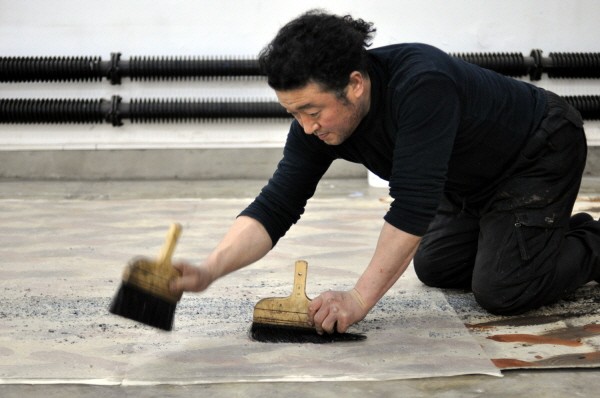
Done dozens of times, the charcoal clots and the panel gains real thickness. Where the brush has worn the paper through, the charcoal underneath comes back up. The result is a black that is not flat and not painted, and none of that survives a catalogue photograph.
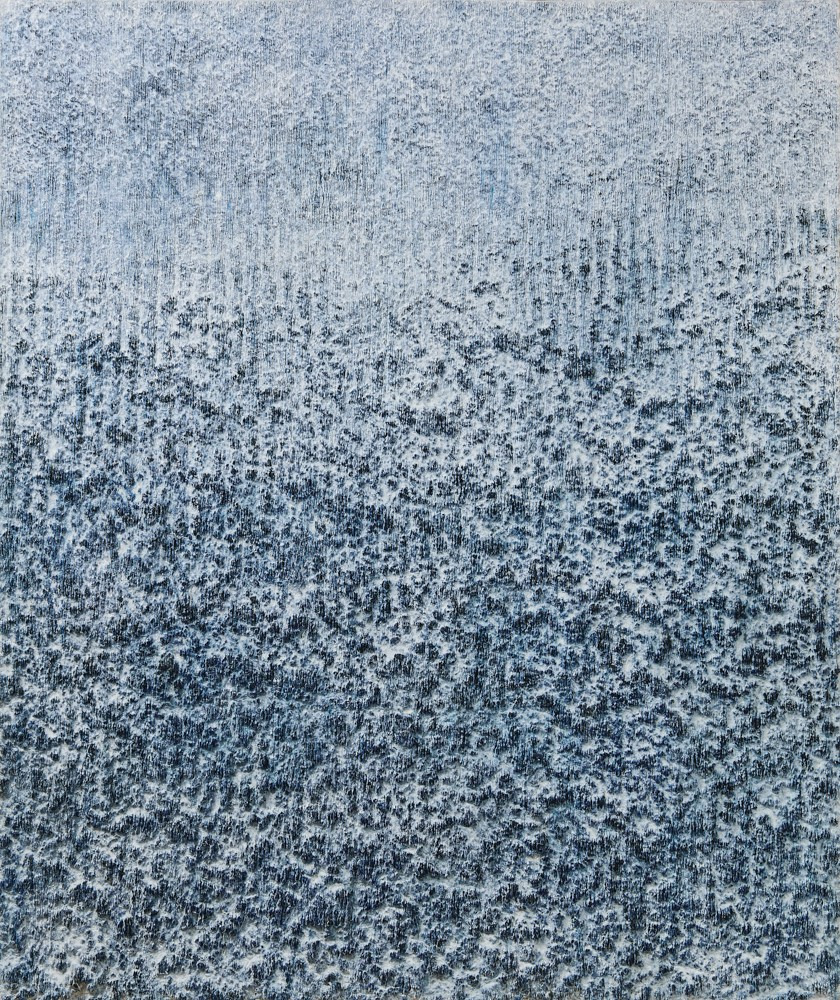
Which brings up something about the record-setting work. It is not black. It is a pale blue and grey field, light at the top, thickening downward. The auction images make his work look like a series of dark rectangles of varying size. Standing in front of one, the difference between a 2018 black canvas and this 2022 blue one is not a variation in tone, it is a different object.
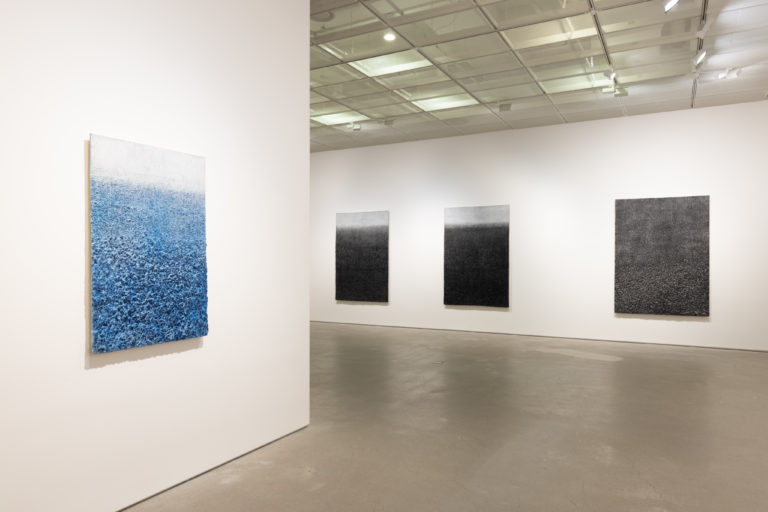
Hung together, the blue one and the black ones do not read as the same body of work seen twice. If you are considering buying one, the auction record is the worst possible way to decide which one. Go and look at three.
The line on the CV that is doing the work
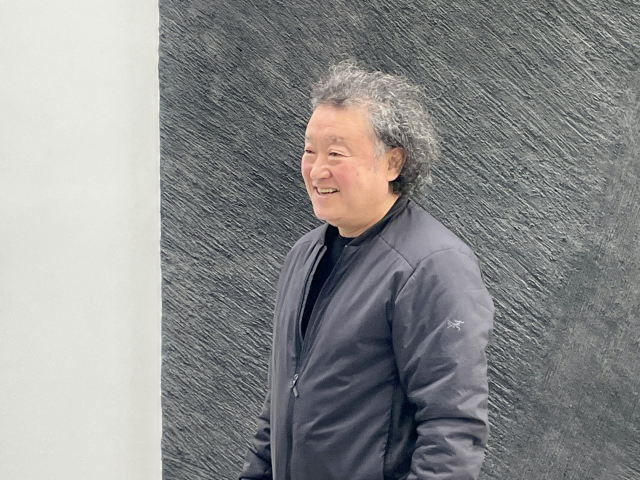
He is 66, born in Seoul in 1959, and has lived in Paris since 1983. Sejong University, then a master's at Paris 8, then the École nationale supérieure des beaux-arts until 1989 studying plastic arts and the materials of art. Forty-three years in the same city, thirty of them on the same method.
The credential everyone cites is the 2024 solo show at White Cube Hong Kong, seventeen works. It is a real show at one of the four or five most powerful galleries on earth, and it should be read carefully. It ran under the gallery's Inside the White Cube programme, which exists to show artists the gallery does not represent. Nobody has misrepresented this. It is just that "solo show at White Cube" and "White Cube artist" are different facts, and a buyer being told the first should know it is not the second.
The line I would look at instead is Galerie Maria Lund in Paris. Six solo shows there between 2007 and 2015, and he is still on the current roster. That gallery splits its artist list into present and past, and as of 4 September 2026 four of the five Korean artists who have passed through it sit in the past column. He is the one who did not.
Museum holdings are Cernuschi in Paris, Daegu Art Museum, and the Long Museum in Shanghai. Asia Society Hong Kong has him scheduled for a solo show in 2027.
Where to look
Leeahn handles the work in Daegu and Seoul. Maria Lund keeps a current artist page in Paris, with one piece marked as belonging to Cernuschi. The Daegu Art Museum owns work and showed it in a 2022 collection exhibition, so it surfaces there periodically. White Cube's exhibition page for the 2024 show is still up with installation views, which is the closest thing to seeing the scale online.
The next three lots will move every percentage on this page. That is not a caveat, it is the actual condition of the market for this artist, and it is why the 2027 Asia Society show matters more to his prices than anything in the table above.
Auction data from K-artmarket, 10 May 2023 to 25 August 2026, retrieved 9 September 2026. Hammer prices, buyer's premium excluded, converted at 1,386 won to the dollar. Biography and exhibition history from the Leeahn Gallery artist page and CV.