Youngju Joung's Paintings Doubled. Her Prints Sold for the Same Price Four Times.
One Youngju Joung silkscreen hammered at exactly 2 million won in April 2023, June 2023, July 2023 and December 2025. Over the same stretch her large paintings went from $67,000 to $130,000.
A Youngju Joung silkscreen sold at auction in April 2023 for 2 million won. It sold again that June for 2 million won. Again in July, 2 million won. It came back in December 2025 and made 2 million won.
Across those same two years and eight months, her large paintings went from a median of about 67,000 dollars to about 130,000.
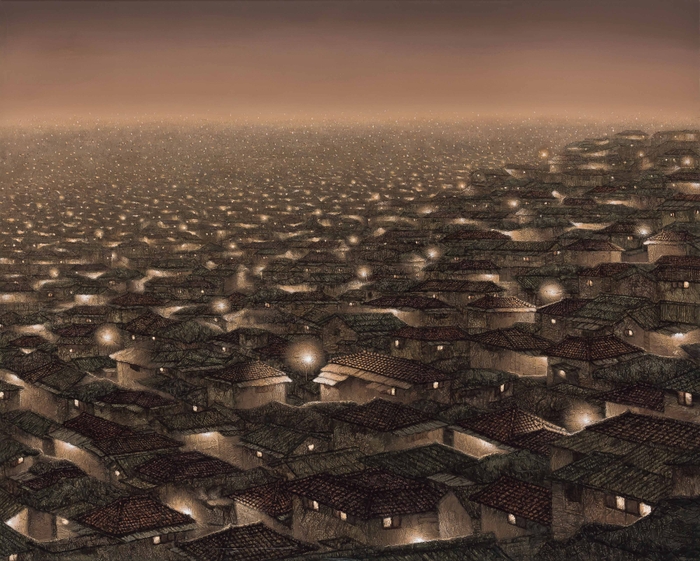
Two markets, one name
Sixty Youngju Joung lots have sold at Korean auction since January 2023: 48 paintings and 12 prints.
| Medium | Lots | Median | Range |
|---|---|---|---|
| Painting, acrylic and hanji on canvas | 48 | $42,929 | $3,247 to $144,300 |
| 12 | $1,479 | $541 to $2,309 |
Twenty-nine times, which is a wider gap than any artist I have looked at so far. But the multiple is the less interesting half. The two columns did not just sit at different levels, they moved in different directions.
Three of her print editions have come back to auction more than once, and every record can be checked against itself.
| Size | Sales | Change | |
|---|---|---|---|
| City, Disappearing Landscape | 76x50cm | Apr 2023, Jun 2023, Jul 2023, Dec 2025, all at $1,443 | 0% |
| Blue Night | 53x38cm | Aug 2023 $1,587 to Nov 2023 $1,515 | 5% down |
| City, Disappearing Landscape | 51x76cm | Aug 2024 $2,309 to Mar 2026 $1,732 | 25% down |
Not one of them rose. The first is the one worth sitting with: four hammers spread over thirty-two months, all landing on exactly the same number, during the period when the artist's name was doing better than it had ever done. Her London and New York gallery shows happened inside that window and the edition did not notice.
There is a reason, and it is not that the prints are bad objects. An edition has copies. When the last copy's price is public and another copy is available, there is no competition and nothing to bid against. The painting market works the other way because each canvas exists once.
The paintings, by size
Korean auction records quote size in ho rather than centimetres, and it is the unit the market actually thinks in. Roughly: 20-ho is 73x53cm, 50-ho is 116x80cm, 100-ho is 162x130cm.
| Size band | 2023 | 2026 | Change |
|---|---|---|---|
| 20-ho | $28,860 | $41,847 | 45% |
| 30-ho | $30,303 | $51,948 | 71% |
| 40 to 50-ho | $46,897 | $85,137 | 82% |
| 80 to 100-ho | $67,100 | $129,870 | 94% |
Every band rose, and the bigger the canvas the more it rose. That pattern is not automatic. Plenty of artists see the small end move first because it is where new buyers can afford to start.
These are medians of between one and five lots per cell, so treat the gradient as the finding and the individual percentages as approximations. The gradient is consistent enough across four bands to be worth acting on.
Big canvases are the cheap ones
Total price and price per unit are different questions, and the second one is the one nobody asks.
| Size band | Lots | Median | Median per ho |
|---|---|---|---|
| 10-ho and under | 9 | $28,860 | $2,886 |
| 20-ho | 13 | $30,303 | $1,515 |
| 30-ho | 8 | $43,651 | $1,455 |
| 40 to 50-ho | 9 | $53,391 | $1,187 |
| 80 to 100-ho | 9 | $79,365 | $882 |
A 10-ho Youngju Joung costs more than three times as much per ho as a 100-ho one. This holds across most of the auction market and it is not a discount for buying in bulk. Small works are where people enter, so demand per centimetre is highest there, and the number of buyers who can hang a 162x130cm painting is small.
If you are choosing between the largest thing you can afford and a small work by the same hand, the record says the large one is better value per unit and will be harder to sell.
Nobody has beaten the estimate
The doubling is real. Here is the part that sits against it.
Four of her top lots have a recorded auction house estimate, and none of them exceeded the high end. Disappearing Landscape 216 took 200 million won in March 2026, a record, against an estimate of 200 to 300 million. It hammered exactly on the low estimate.
Estimate $144,300 to $216,450. Hammered on the low end.
Disappearing Landscape 1123 made 195 million against 180 to 240. Evening Road made 125 million against 100 to 180. Only one of the four, a 100x72cm canvas at 112 million against 70 to 140, landed above the middle of its range.
This is the useful corrective to a chart that goes up. The houses have been raising their estimates as fast as the results, and buyers have been paying inside the range rather than fighting past it. A market where the record price arrives on the low estimate is a market that is being led by the trade rather than running ahead of it.
What the BTS purchase did and did not do
In 2020 RM of BTS bought a Youngju Joung painting, Disappearing Hometown 730, 150x150cm, for 50 million won, about 36,000 dollars at today's rate. He had seen the work at Galleries Art Fair in February and met the artist at Sun Gallery in March. Korean press covered it as news, which for a painter who had been showing since 1995 was a different order of attention.
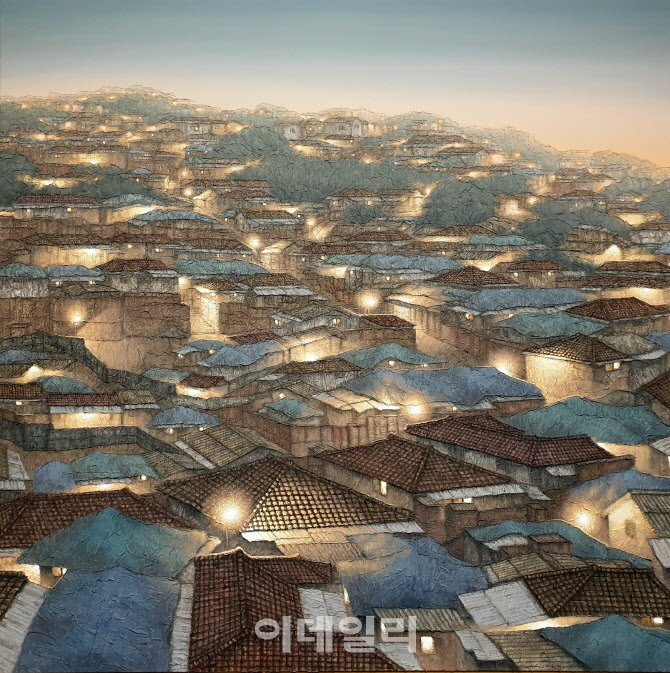
It is tempting to draw a line from that purchase to the numbers above, and the line does not quite hold. The auction record only begins in 2023, three years after the sale, so nothing here measures what the purchase did to prices. What is visible is that a 150x150cm canvas of hers now sits in a band whose median is 79,365 dollars, and that her 2022 solo show at Hakgojae in Seoul is the event Korean dealers point to when they explain the demand rather than the RM sale.
The international line is more recent. Almine Rech, the Brussels gallery, now represents her. She had a first solo show with them in London in November 2024 and a second in New York in March 2026.
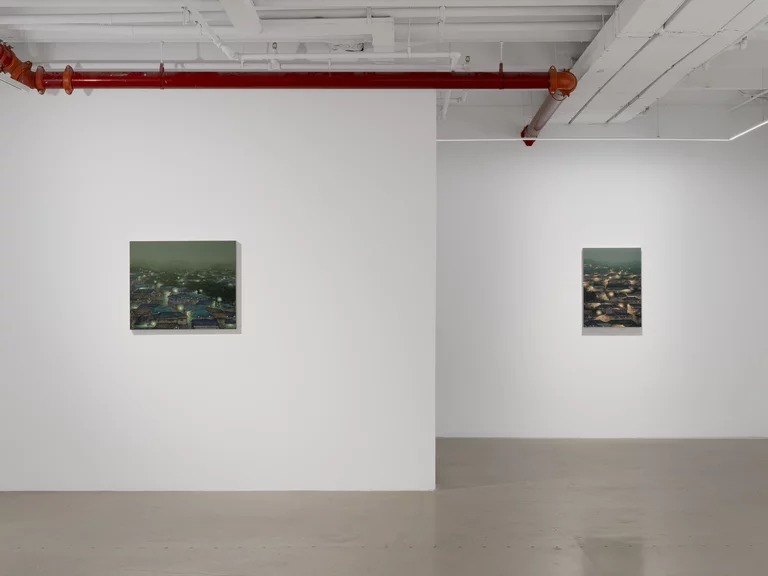
Worth knowing if you are reading listings in two languages: the auction records use her Korean series titles, translated here as Disappearing Landscape, Disappearing Hometown and Evening Road, while Almine Rech titles the same kind of work Way back home, Village, Memory and Snowscape. Same paintings, different naming, and a search in one language will miss half the record.
The part a photograph cannot carry
She sketches the composition on canvas, then crumples and tears hanji, the Korean mulberry paper, into roof and wall shapes and glues them down one building at a time. It dries, and then she paints it in acrylic.
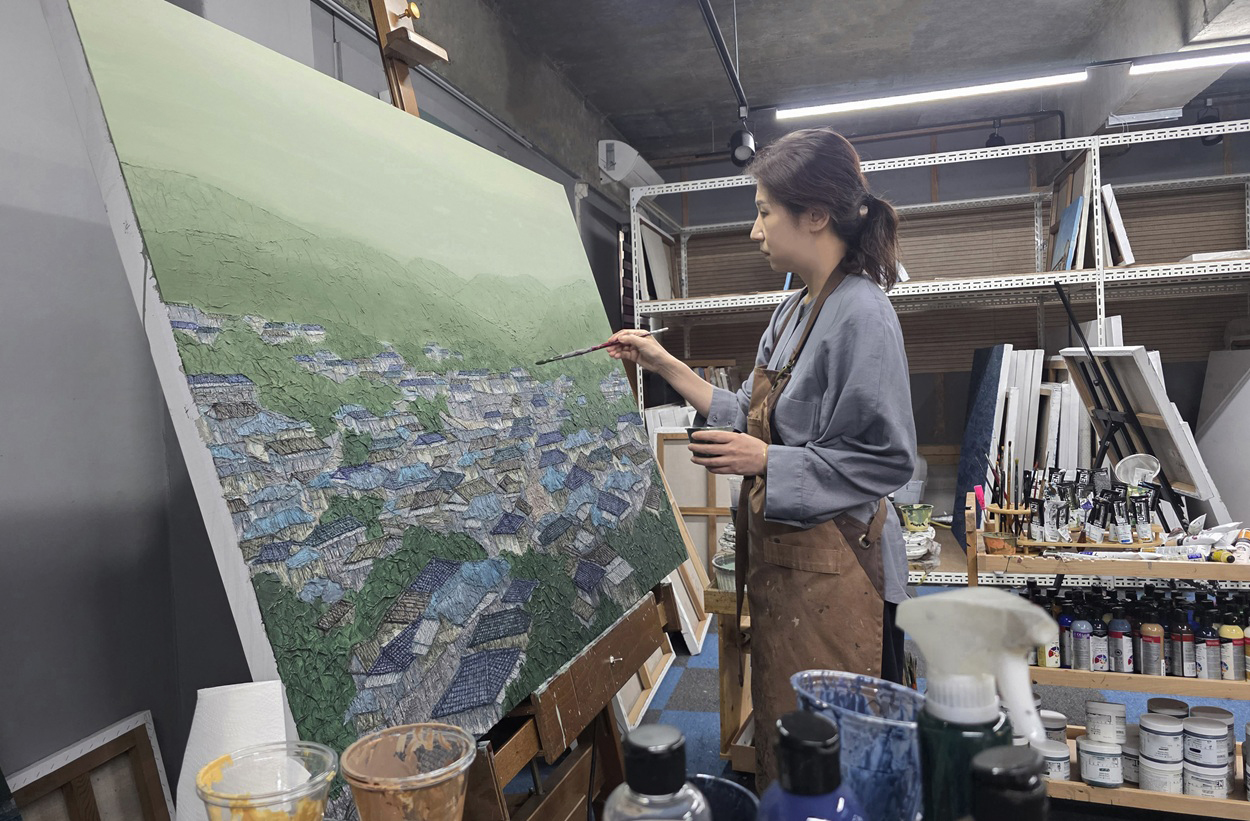
The overlapping paper leaves real ridges where the roofs and walls are, so the surface is closer to low relief than to paint on a flat plane. Paper also holds light differently from primed canvas, which is why the lit windows look as though the light is coming through them rather than sitting on top.
None of that survives a catalogue photograph, which flattens the whole thing into a picture of a hillside at night. The studio shot above, lit from the side, is the only image on this page where you can see what you would actually be buying.
She paints hillside shanty settlements, the neighbourhoods that get cleared for redevelopment, almost always after dark. Nobody is in them. The lit windows stand in for the people, which she has said is the point.
Where to look
Almine Rech has her artist page and both exhibition archives online, London 2024 and New York 2026, with full installation views. Hakgojae in Seoul staged the 2022 show. Two museum group shows in China opened in 2026, at Guangdong Museum of Art and X Museum in Beijing.
If a painting comes up, the two things to settle before the price are the size in ho and whether you have seen it in person or only in a plate. On this artist those two questions do more work than the year of the sale.
Auction data from K-artmarket, 18 January 2023 to 26 August 2026, retrieved 9 September 2026. Hammer prices, buyer's premium excluded, converted at 1,386 won to the dollar. Exhibition history from Almine Rech and Hakgojae.