Isa Genzken's Biggest Multiple Was Her Cheapest Painting
A Genzken diptych made $258,000 on an $80,000 estimate at Phillips in July 2026, the largest multiple in the sale. Measured by area it is the cheapest Basic Research painting of the five whose prices can be traced.
On 16 July 2026 an Isa Genzken sold at Phillips in New York for $258,000 against an estimate of $80,000 to $120,000. It was the largest multiple over estimate in the sale, and the only lot that both doubled its estimate and cleared six figures.
Genzken is known as a sculptor. Concrete, plaster, and the assemblages of the 2000s are what her name carries. This lot is a painting, and by the only measure that lets you compare it with the rest of its series it is the cheapest one anybody has bought.
A sculptor's paintings
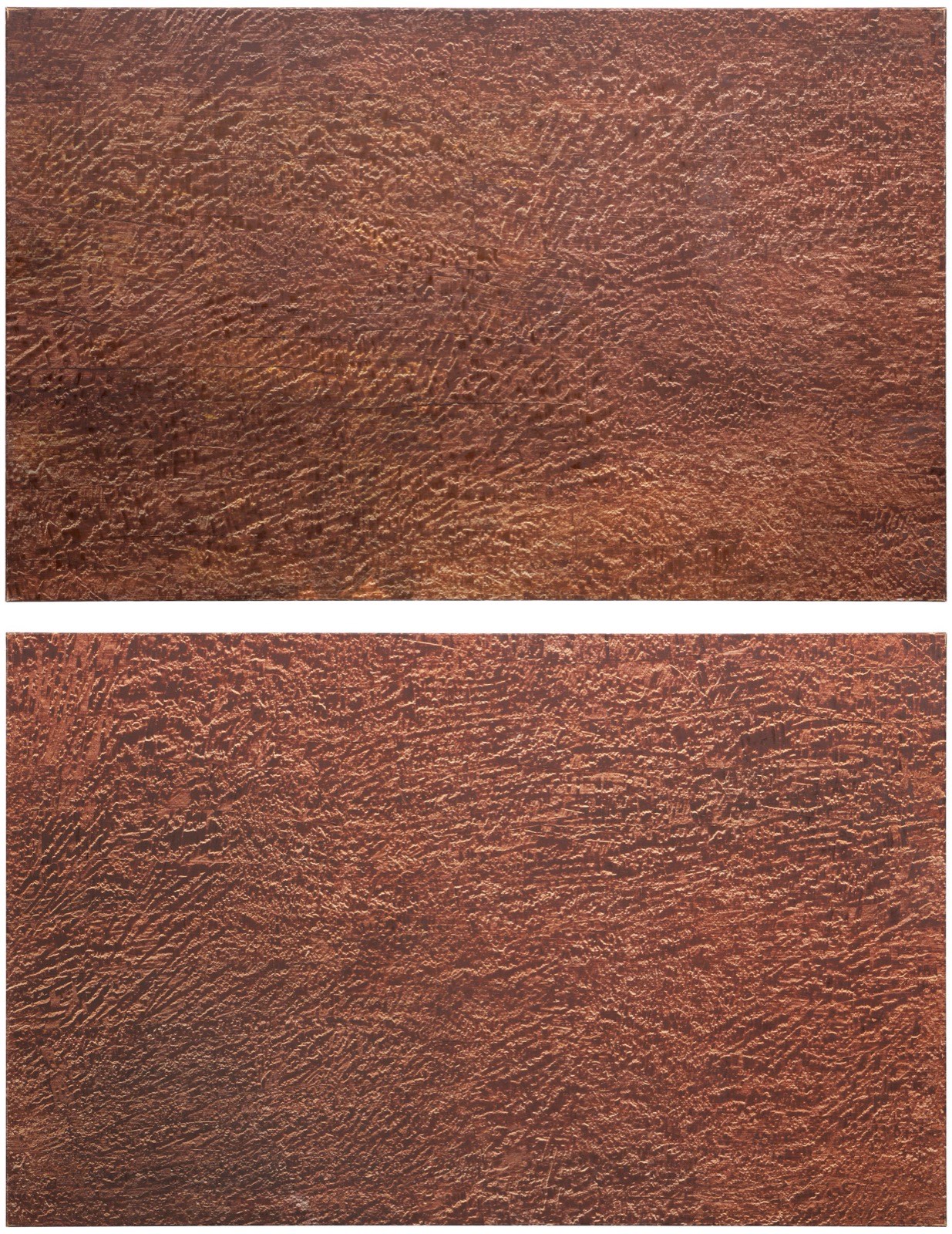
Between 1989 and 1991 Genzken made a series of paintings called Basic Research. The method is the whole thing.
She laid primed canvas on the floor of her studio and pulled oil paint across it with a squeegee, so the canvas took an impression of the floor underneath: its unevenness, its grit, whatever had been left lying there. She did not sweep first. What was on the floor became the picture. It is frottage, the trick of laying paper over a coin and rubbing a pencil across it, scaled up to the size of a room.
The squeegee marks stay visible, so the surface explains its own making.
The July lot is a diptych, each canvas 198.1x127cm, signed on the reverse of each. Hung as a pair it runs close to four metres.
Seventeen lots, and the estimates miss in both directions
The obvious reading of a 2.15x is that the house pitched her too low. Phillips publishes seventeen Genzken lots on its own artist page, and across all seventeen that reading does not hold.
Seven of the seventeen either sold under the low estimate or carry no published result at all. The four that fell short:
| Work | Estimate | Result |
|---|---|---|
| Schindler, 1988, concrete and steel | $350,000 to $550,000 | $341,000 |
| Urlaub, glass, lacquer, plastics, metal, wood | $80,000 to $120,000 | $75,000 |
| Four works: Untitled | $8,200 (£6,000) to $10,900 (£8,000) | $5,200 (£3,810) |
| Mona Isa | $680 (£500) to $950 (£700) | $440 (£323) |
Schindler is the most expensive lot in the whole Phillips record and it still failed to reach its low estimate, in an evening sale, at 216.3x53x64.6cm of concrete. The three lots with no published figure are Soziale Fassaden, Oskar and Empire/Vampire. Phillips normally prints a number beside a lot that sold and there is none beside these, but the page does not say bought in either way, so I am not going to tell you they failed.
A house that habitually underestimates an artist does not produce that table. If anything Phillips has aimed high on Genzken more often than low.
Some of that weakness is supply rather than appetite. Four of the seventeen lots were in one room: Soziale Fassaden, Urlaub, Oskar and an early Untitled drawing all came up in the same New York day sale in 2014. Two published no result, one sold under its low estimate, one over. Four lots by one artist in a single sale divide the bidders who came for her.
The table settles one other thing worth knowing before you read a Genzken result. Sixteen of the seventeen are unique works: the paintings, the concrete, the assemblages, the drawings. The only edition is Mona Isa, a photographic print numbered 19 from 120, which made $440. An artist known for sculpture might be expected to reach the salesroom mainly through multiples. This one does not, which means the prices above are prices for singular objects.
So the July multiple is not a fact about Genzken. It is a fact about one series, and you have to go series by series to see it.
Five Basic Research sales, measured by area
Five sales of Basic Research paintings can be traced: four at Phillips and one at Lempertz in Cologne.
Comparing them means putting three currencies together, so everything below is converted at 1.36 dollars to the pound and 1.16 to the euro, the rates on 9 September 2026. These sales run from 2016 to 2026 and the real rates on those days were different, so treat the per area column as an approximation rather than a measurement. The original hammer figures are in brackets. Sizes are given width first, which reverses the order Phillips prints them in: auction catalogues list height before width.
| House | Year | Made | Size | Area | Estimate | Result | Per cm2 |
|---|---|---|---|---|---|---|---|
| Lempertz | 2016 | 1989 | 60x45cm | 2,700cm2 | $34,800 to $46,400 | $43,200 (EUR 37,200) | $16.00 |
| Phillips New Now London | 2020 | 1989 | 60x45cm | 2,700cm2 | $40,800 to $68,000 | $41,100 (GBP 30,240) | $15.20 |
| Phillips New Now London | 2021 | 1992 | 72x52cm | 3,744cm2 | $40,800 to $68,000 | $111,400 (GBP 81,900) | $29.75 |
| Phillips New Now London | 2023 | 1989 | 60x44.9cm | 2,694cm2 | $27,200 to $40,800 | $34,500 (GBP 25,400) | $12.80 |
| Phillips New York | 2026 | 1989 | diptych, each 198.1x127cm | 50,317cm2 | $80,000 to $120,000 | $258,000 | $5.13 |
Two things fall out of that table.
The first is that the July lot is not in the same weight class as the others. The four earlier paintings are all around A2, and the three at Phillips all came through New Now, which is the house's lower tier. The diptych has roughly nineteen times the area of the smallest of them and it hung in the main Modern & Contemporary Art sale. Same series, different object.
The second is the one that matters. Per square centimetre the diptych is the cheapest of the five, at about $5.13 against a median of $15.59 for the four small ones. That is a third of the rate. Against the dearest of them, the 1992 painting at $29.75, it is a sixth.
Small pictures costing more by area is ordinary. They are easier to buy, easier to hang, easier to sell again, and large work carries a discount because the pool of people with the wall is smaller. A gap of three to six times is still steep.
What the multiple actually says
Put the two halves together and the July result stops being mysterious.
An estimate of $80,000 to $120,000 sits roughly where the small Basic Research paintings had been trading, which suggests it was built from those comparables with a heavy size discount applied on top. The painting had nineteen times the area and got an estimate in the same band.
From a start that low, 2.15x is not hard to reach. And $258,000 is not a strong price for this series. By area it is the weakest of the five.
The multiple and the price are answering different questions. One tells you how far the room went past the estimate. The other tells you what the picture cost. Reading the first as though it were the second is how a lot that sold cheaply gets written up as a breakout.
The same panel, offered twice
Two of the seventeen are one object. Soziale Fassaden came up in a New York day sale in 2014 at 60x40cm and again in 2016 at 60x40.6cm, both dated 2002, both catalogued as unique. The 0.6cm is the difference between writing 15 3/4 inches and writing 16.
The plates settle it. Both show the same arrangement: a vertically striped upper panel, a band of orange reflectors across it, a silver band set off to the right below that, then a horizontally striped lower panel. The step in the right edge matches. So does a small dark mark on the top edge, in the same position in both photographs. The lighting differs and nothing else does.
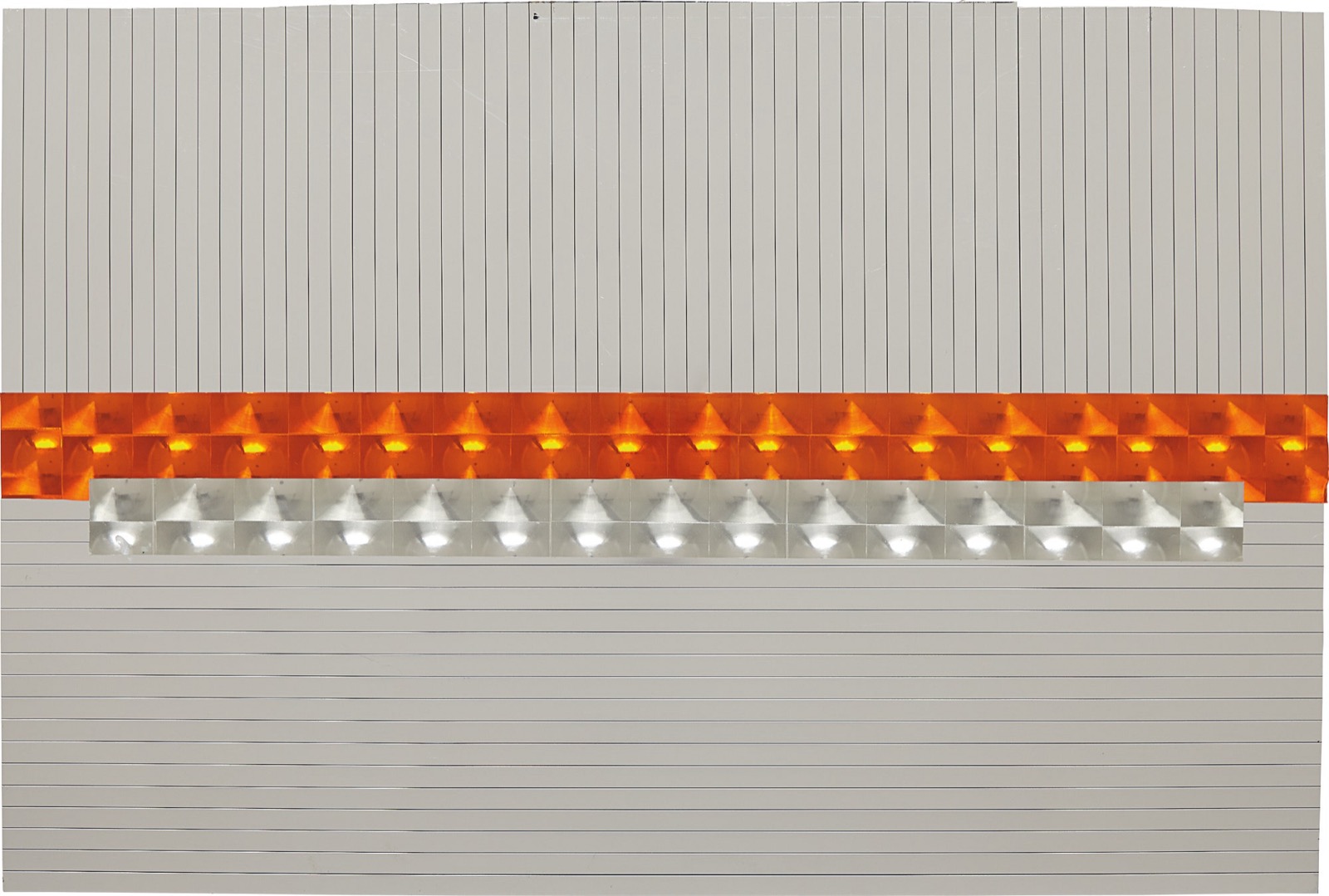
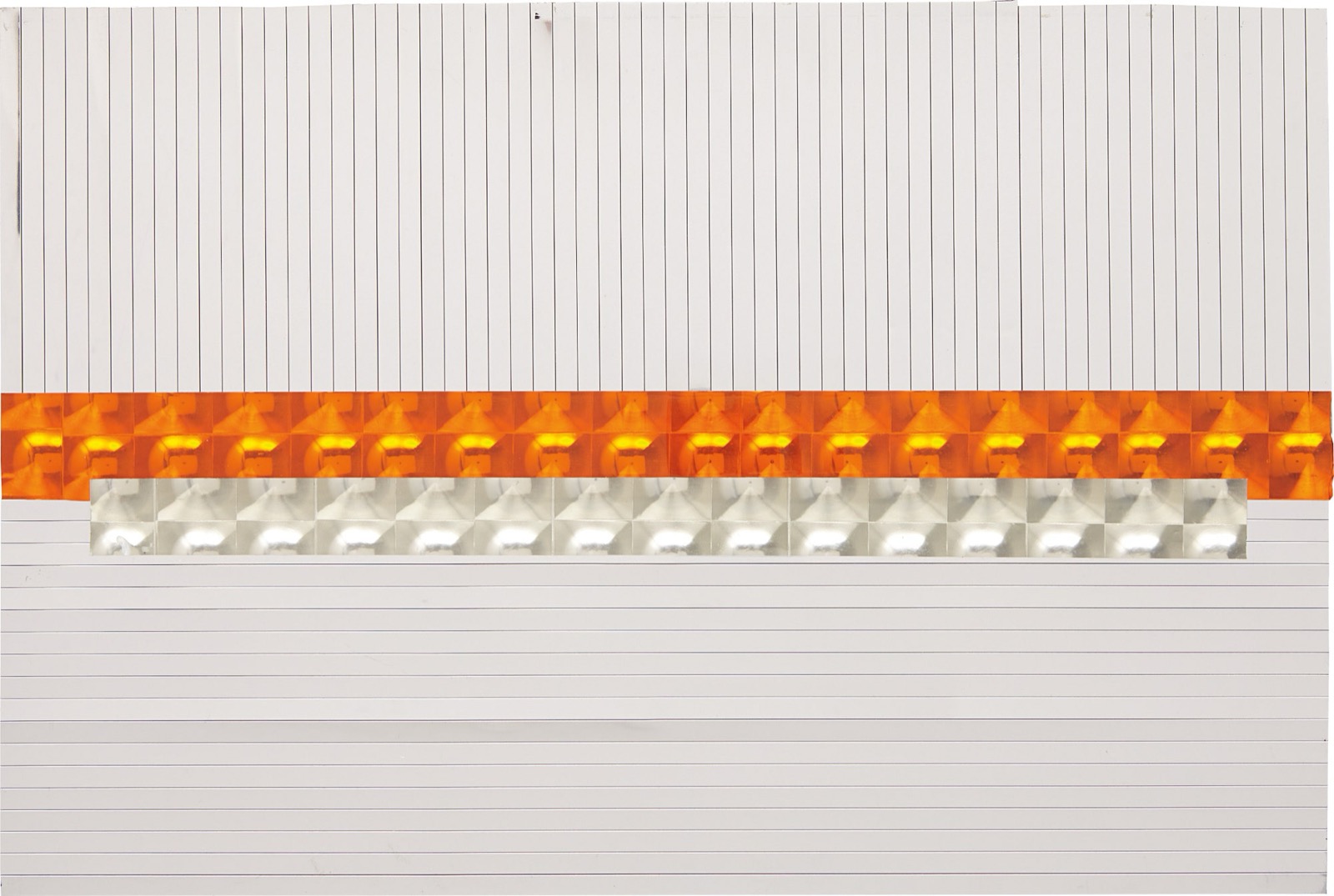
In 2014 the estimate was $40,000 to $60,000 and no result was published. In 2016 the estimate was $15,000 to $20,000, a quarter of the first one, and the panel sold at the bottom of that range for $15,000.
A lot that fails leaves a mark on the work rather than on the house. The next consignment starts from a lower number, and here the reduction was three quarters on an object Phillips had already handled once.
Two other lots look like the same trap and are not. The Basic Research paintings of 2020 and 2023 are both dated 1989 and measure 60x45cm and 60x44.9cm, close enough to read as one picture offered twice. The plates show otherwise: the 2020 painting carries a single diagonal ridge across the middle, the 2023 one a stack of horizontal ridges over the whole surface. Different floors, different pictures, and the area comparison above counts them correctly.
The ceiling this table does not show
Everything above comes from one house, and Phillips is the third of the three. Her own record was set elsewhere. Fenster, a concrete and steel work of 1990 measuring 225x80x48cm, sold at Sotheby's in London in the contemporary evening sale on 2 June 2020 for $920,700 (GBP 677,000 at the rate used here, reported at around $870,000 on the day).
That is 2.7 times the top of the Phillips table. Only two of these seventeen lots were evening sale material. The rest came through day sales, New Now and online, which is the tier a third house gets when the best consignments go to the other two. Read the numbers above as one saleroom's second shelf, not as what a Genzken costs.
The paperwork around the series
Basic Research is not a sculptor's side project, and the exhibition history is the evidence.
The ICA in London gave the series its own show, Isa Genzken: Basic Research Paintings, in 2015. Fondazione Sandretto Re Rebaudengo showed Basic Research Paintings 1989 to 1991 in Turin in 2014. Galerie Buchholz in Berlin ran Isa Genzken: Basic Research from 14 February to 12 April 2025. The paintings were in her MoMA retrospective of 2013 and 2014, which produced an audio guide entry on them.
The July lot also carries a literature note: the work will be included in the forthcoming Catalogue Raisonné published by Galerie Buchholz, Köln. A catalogue raisonné is the numbered inventory of everything an artist made, and being listed for inclusion means a work has been placed inside that record rather than left for a future owner to prove.
The Buchholz show and the Buchholz catalogue are the same gallery in the same stretch of years. That looks like a series being organised. I am describing a coincidence in the dates, not a cause.
Buying into a name this established
Genzken is not an artist anyone is discovering. She had a retrospective at MoMA in 2013 and 2014, then Amsterdam in 2015, Basel in 2020 and 2021, Berlin in 2023. She was in the Venice Biennale five times and represented Germany there in 2007. David Zwirner states the representation plainly: "Since 2004, her work has been represented by David Zwirner." Hauser & Wirth carries her as well.
The useful question is not whether to look at her but which part of her to look at, because the parts price differently. Schindler, a concrete sculpture, made $341,000. The small Basic Research paintings sit between $34,500 and $111,400. The 2015 mixed media Untitled on canvas made $103,600 (GBP 76,200) against an estimate topping out at $74,800 (GBP 55,000). Medium and series, not the name, set the band.
The other thing this record teaches is not to price a large work by multiplying a small one. Nineteen times the area bought about six times the money here, and the direction of that error is consistent enough to plan around.
What I could not confirm
Two more Basic Research paintings appear to have sold in 2026, on 21 February and 10 June, and I could not establish either price. Artnet holds them behind a paywall and the pages return errors. The dates do not match Phillips's own sales, so another house handled them. The five sales above are enough to support the comparison, but a complete picture of the series would need those two.
Whether MoMA owns a Basic Research painting or borrowed one is also unresolved. The series was in the retrospective and the museum published audio on it, which is not the same as a credit line, so I have not called it a MoMA work above.
The Phillips ceiling of $341,000 is not her ceiling, and I have said above what is: Fenster at $920,700 in 2020. What I have not built is a full cross house record. Sotheby's and Christie's results beyond that one lot, and the German salerooms, are outside what I checked, so treat the seventeen lots here as one house's sample rather than a market.