What AP, HC and 12/50 Mean on a Print, and What They Do to the Price
How to read the pencil marks in the margin of a print: edition numbers, artist's proofs, HC and plate signatures. With 66 Yayoi Kusama auction photographs read one by one, and what they could and could not show.
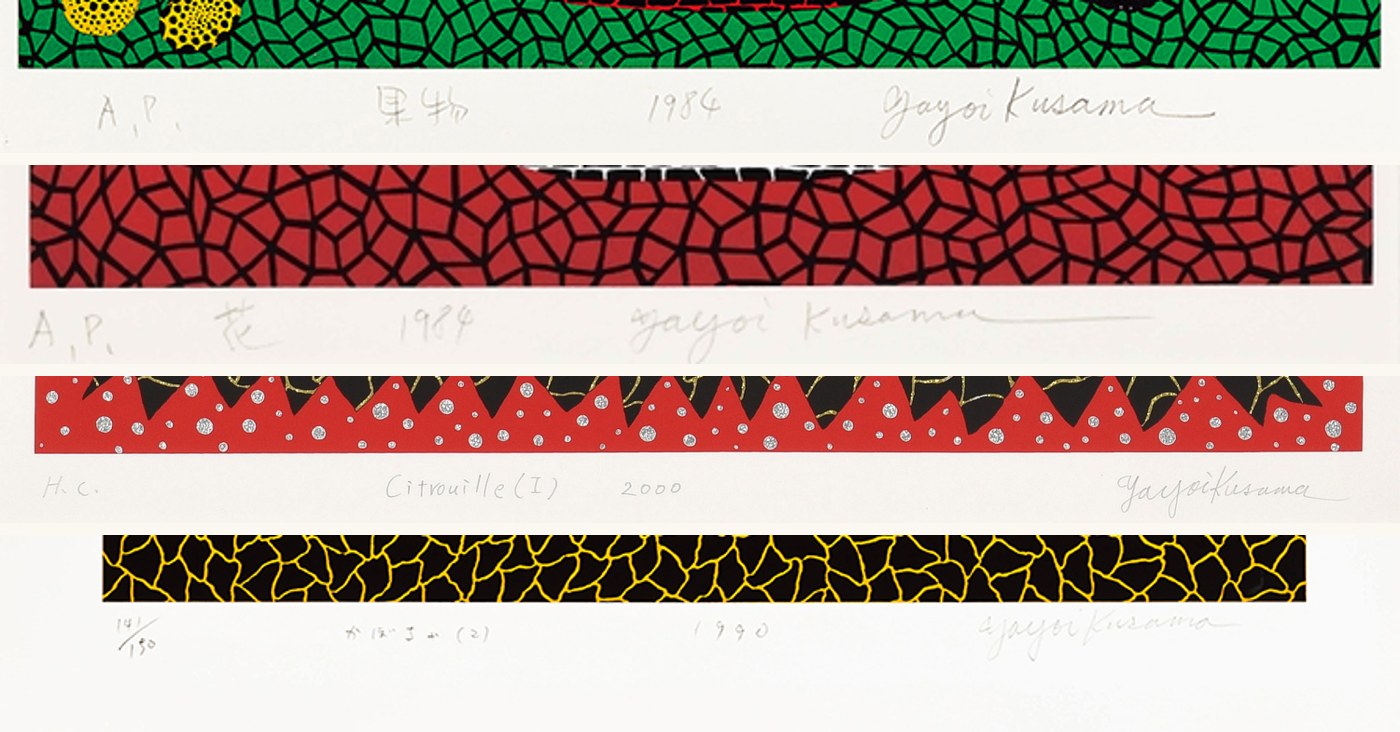
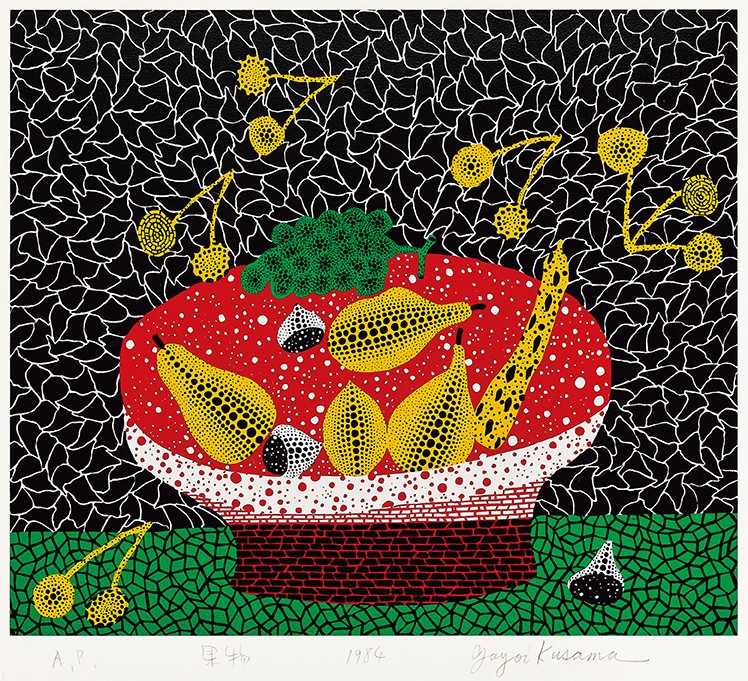
Under a Yayoi Kusama screenprint that sold at Seoul Auction in August 2022 for $35,052, four things are written in pencil. From the left: A.P., the Japanese word for fruit, 1984, and her signature. Where the edition number would normally go, there is no number.
That strip of margin carries most of what a buyer needs to know about a print, and the Korean auction records I work from almost never show it. K-artmarket, the database of Korean auction results I use for this site, has no field for it. Across 1,142 records for six artists, two record an edition number or a proof mark. So I read the margins off the auction photographs instead: 66 of them, all Kusama, and 32 had a margin to read.
Where are the marks on a print?
On most prints the edition number sits at the lower left, the title in the middle and the signature at the lower right. The International Print Center New York's glossary puts it plainly: "Each print in a limited edition is usually numbered in the lower left-hand margin". A date often sits beside the title.
Kusama follows that order. Her titles are often in Japanese, so the words in the margin may not match the English title in an auction catalogue: 果物 is fruit, 花 is flowers, かぼちゃ is pumpkin. Some sheets put the marks inside the image instead. On her Eyes Flying in the Sky, the number and signature are written into the picture itself.
What does 12/50 mean on a print?
The first number is the individual sheet, the second is the size of the edition. Sotheby's guide to reading an edition says "The number before the slash identifies the individual impression, while the number after the slash indicates the total number of examples produced within the edition". So 12/50 is the twelfth of fifty.
The second number matters more than the first. Kusama's Pumpkin (2) from 1990 is an edition of 150, Pumpkin MT from 1999 an edition of 110, and the green Pumpkin (GT) from 1996 an edition of 120. In each case I found the edition size in the margin before I found it anywhere in a sale record.
Does a lower number mean a better print?
Generally not. The same Sotheby's guide says "number 5 from an edition of 100 is generally considered equivalent to number 95 from the same edition, assuming both works are comparable in condition and provenance".
Nor does the number record the order of printing. Handprinted, a UK printmaking supplier, notes that "Prints are not necessarily numbered in the order in which prints were taken". The idea that number 1 came off the press first and is sharper does not hold for most modern screenprints and lithographs.
What does AP mean on a print?
An artist's proof is a sheet kept for the artist, outside the numbered edition. The IPCNY glossary defines it as "A print reserved for the artist and not included in the numbered edition". In French it is written E.A., for épreuve d'artiste.
The convention is about a tenth of the edition. Brier Hill Gallery describes it as "an additional number of proofs not exceeding ten per cent of the edition size". In practice it is often more: Sotheby's cites a Warhol edition of 250 with 50 proofs, and a Picasso edition of 50 with about 20.
An edition of 150 does not mean 150 sheets exist. Sotheby's again: "the published edition size does not always represent the full number of impressions in circulation".
What does HC mean on a print?
HC stands for hors commerce, French for not for trade. Sotheby's print collecting guide explains that "Historically hors commerce proofs were intended for the artist and their collaborators, hence the implication that they are not to be sold". The same guide adds that they often reached the market anyway, because they were part of what the artist was paid. A Kusama Citrouille (I) marked H.C. sold at Raiz Art in Seoul in September 2022 for $86,512.
The other proof marks you will see, as Sotheby's defines them:
| Mark | Meaning |
|---|---|
| PP | Printer's proof, kept by the printer or publisher, identical to the edition |
| BAT | Bon à tirer, the approved sheet the edition is matched to, usually only one |
| TP | Trial proof, pulled while the artist was still working, so it can differ from the edition |
| CTP | Colour trial proof, printed in colours different from the final edition |
Are artist proofs worth more than numbered prints?
Not automatically. Sotheby's is direct about it: "they should not automatically be viewed as more important or more valuable". Some collectors want them for their scarcity and their link to the printing, but the image is the same, and the demand depends on the artist and the work.
The Korean records do not show a premium either. Kusama's Fruits of 1984 sold three times in Seoul.
| Sale | House | Margin | Price |
|---|---|---|---|
| Apr 2022 | K Auction | Not shown in the photograph | $35,798 |
| Aug 2022 | Seoul Auction | A.P. | $35,052 |
| May 2024 | K Auction | Not shown in the photograph | $26,103 |
The proof sold for about what the same image had made at K Auction four months earlier. The catch is that K Auction's photographs crop the margin away, so I cannot tell whether those two were numbered sheets or proofs as well. Three sales of one image cannot say whether an AP is worth more or less.
What the Korean auction photographs show
Of the 66 Kusama print photographs I read from Seoul Auction and Raiz Art, all sales at or above 3 million won:
| Margin | Sheets |
|---|---|
| Numbered, such as 141/150 | 29 |
| A.P. | 2 |
| H.C. | 1 |
| No margin in the photograph | 34 |
Raiz Art photographed the whole sheet on all ten of its lots. Seoul Auction did on 22 of 56. K Auction, which sold 97 of the 165 Kusama prints in the records, crops every one I looked at to the image.
This matters most when you compare past sales. Two records with the same title and size might be one sheet resold, two different numbers, or a proof and a numbered sheet, and the record will not tell you which.
What does signed in the plate mean?
A plate signature is part of the printed image; a pencil signature was put on each sheet by hand. J.D. Smith Fine Art describes the first as the artist scratching their name into an etching plate or writing it on a lithograph plate, so that it prints with every impression.
The difference in price can be large. Writing about Picasso, Ledor Fine Art says plate-signed prints "tend to be priced like unsigned pieces" and that "a signed impression generally sells for around twice the price of an unsigned one". That ratio is Picasso's. It will not carry over to every artist.
Blindstamps, estate stamps and restrikes
A blindstamp is an embossed mark pressed into the paper by the printer or publisher, identifying who made and issued the edition. Graphicstudio at the University of South Florida describes it as a mark applied to every print of an edition, proofs included.
An estate stamp is applied after the artist's death in place of a signature. Ledor notes that Picasso's heirs authorised one for posthumous editions, and that it does not add nearly as much value as a pencil signature.
A restrike is, in Brier Hill's words, "a print made using the original matrix (block, plate, screen, etc.) subsequent to, and unrelated to, the original publishing venture". Same plate, different object.
An open edition has no limit. Avant Arte's glossary: "An open edition refers to an edition of prints or artworks with no set limit on the number of copies that will be produced". One resin Kusama pumpkin sold in Korea was listed as exactly that. Giclée, as the IPCNY glossary notes, is "Giclée (the French term for inkjet)": a digital print.
Can a Kusama print be authenticated?
Not through her own offices. The registration page on Kusama's official site lists "works that are not eligible for registration, such as prints/editions", and says of the service: "It is not a service for authentication". A notice from the Yayoi Kusama Museum on counterfeit works says the museum is "unable to provide any authentication services or to respond to inquiries regarding the authenticity of prints", and adds: "Please note that forged certificates of authenticity have also been identified".
For her prints, then, the paper that matters is the sale history and the margin, not a certificate.
What to check before you bid
Ask for a photograph of the whole sheet. The number, any proof mark, the title, the date and the signature all live in the margin, and a catalogue photograph cropped to the image hides all five.
Read the number after the slash. It tells you the edition, and a different edition under the same title is a different thing to buy.
Do not pay more for a low number. Number 5 and number 95 are generally treated alike if their condition is the same.
Do not assume a proof carries a premium. Ask instead how many proofs exist outside the edition.
Check whether the signature is in pencil or in the plate.
For an artist whose own offices do not authenticate prints, weigh the provenance above any certificate.
Korean auction data from K-artmarket, retrieved September 2026. Margin inscriptions read from Seoul Auction and Raiz Art photographs published there. Korean prices are hammer prices, converted at 1,340.86 won to the dollar (rate of 9 September 2026). Definitions from Sotheby's, the International Print Center New York, Brier Hill Gallery, Handprinted, J.D. Smith Fine Art, Ledor Fine Art, Graphicstudio at the University of South Florida and Avant Arte; Kusama registration and authentication policy from her official site and the Yayoi Kusama Museum, retrieved 15 September 2026.